6 hours ago
Dallas Church Wins Three-Year Approval to Keep Pride-Themed Rainbow Steps
READ TIME: 3 MIN.
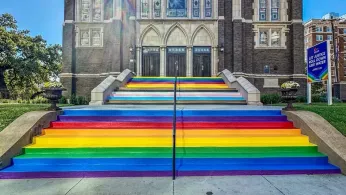
The Dallas Landmark Commission has unanimously voted to allow a set of Pride-themed rainbow steps to remain at Oak Lawn United Methodist Church for at least three years as a temporary art installation. The decision, reached at a public meeting at Dallas City Hall on Monday, followed a sustained show of support from community members, LGBTQ+ residents, and congregants of the historic church.
Oak Lawn United Methodist Church, located on Oak Lawn Avenue in Dallas’ Oak Lawn neighborhood, painted its front steps in the colors of the Progress Pride Flag in October 2025. The Progress Pride design includes the traditional rainbow alongside additional stripes representing transgender people and Black, Brown, and other marginalized LGBTQ+ communities. According to church leaders, the steps were intended as a visible declaration of welcome and solidarity with LGBTQ+ people in the surrounding community.
The church’s decision to paint the steps came shortly after Texas Governor Greg Abbott directed state transportation officials to require cities to remove rainbow crosswalks and other street markings that he characterized as “political ideologies. ” Abbott also threatened to withhold funding from cities that failed to comply, a move that led to the repainting of rainbow crosswalks in several Texas cities, including Dallas. In that context, Oak Lawn United Methodist Church leaders described the steps as both a pastoral act of hospitality and a public response to the removal of inclusive symbols from nearby streets.
Because the church building is a designated historic landmark, any major exterior changes, including new paint colors, must be approved by the Dallas Landmark Commission. City staff noted that Oak Lawn United Methodist Church did not submit an application before painting the steps, which triggered a review once the installation was reported.
Ahead of the commission’s vote, more than 20 people signed up to speak during public comment, and all who spoke at the meeting voiced support for allowing the rainbow steps to remain. Local residents, faith leaders, and LGBTQ+ community members emphasized the significance of visible affirmation in a neighborhood long known as a center of LGBTQ+ life in Dallas. One supporter told commissioners that “we have one street that represents this culture and we have one church with rainbow steps, ” underscoring the symbolic weight of the installation.
The Rev. Rachel Griffin-Allison, senior pastor of Oak Lawn United Methodist Church, told commissioners that the congregation has been part of the community for more than 150 years and has worshiped at its current site for over a century. She said the church chose to act in a moment when “symbols of welcome and belonging” were being removed nearby and explained that the intention was “to communicate to every person who approaches our building that they are seen, safe, and welcome. ”
City preservation staff recommended approval of the steps as a temporary art installation, with conditions that no paint be applied to the church’s exterior brick, that the installation be reconsidered after 12 months, and that any lighting comply with city code. A separate advisory task force had recommended denial without prejudice, citing concerns that the bright colors might not align with the building’s historic color scheme. During the meeting, commissioners noted that the steps had been painted in the past, that the rainbow design did not damage the historic structure, and that it would be reversible if removed.
After public testimony and staff presentations, the Landmark Commission voted unanimously to allow the Pride-themed steps to stay for three years as a temporary art piece, with the possibility of extension or removal after that period. Commissioners also acknowledged the broader cultural context, with one speaker insisting that “rainbow steps shouldn’t be controversial” and describing the installation as “just paint. ”
For many LGBTQ+ Dallas residents and allies, the vote represents a rare instance in which an affirming symbol has been permitted to remain amid broader efforts to restrict queer and transgender visibility in public spaces across Texas. Advocates say the rainbow steps now function as both an expression of faith-based inclusion and a highly visible marker that LGBTQ+ people are welcome and valued within the Oak Lawn community.